Learning objectives
In this module, you will learn how to develop new narratives on migration through correct information, pluralistic and accurate communication. Start by learning the principles of journalistic codes of conduct and explore practical recommendations and collaborative experience that amplify voices from different backgrounds in news production.
- Principles of ethics and codes of conduct: how to communicate accurately and correctly
- The Marseille Charter: 11 principles to follow
- From "alternative narratives" to "new narratives": how to generate new forms of communication
- The role of networks among journalists, new media, and digital platforms of citizen journalism. Examples
- How to promote practices for broad and inclusive information, with the protagonism of racialized people and people with migrant backgrounds (Recommendations)
- Quiz
Introduction: ethical principles, deontological charters and codes of conduct on migration and discrimination
Across Europe, numerous ethical charters, codes of conduct and guidelines help journalists and communicators address the topic of migration in an accurate, responsible and dignity-respecting way. In Italy we have the Charter of Rome, in Greece Charter Idomeni, in Spain Código Deontológico de la FAPE, in Malta the Code of Journalistic Ethics (from the Istitut tal-Ġurnalisti Maltin). To these tools we can add the guidelines produced by international bodies such as the UN, UNHCR, UNESCO, IOM, the Council of Europe, the European Union, as well as materials developed by journalist collectives and media observatories that have been working for years to improve the quality of information on migration.
Despite their differences, these documents share several fundamental elements:
- A reference to the basic principles of journalism
- The centrality of verifying sources and the accuracy of communication
- Respect for people's rights and dignity
- And the commitment to reporting the substantial truth of facts without resorting to stereotypes, simplifications or stigmatizing narratives
They are working tools, not burdens to carry. We invite you to see them as practical resources to use and "wear out" daily, helping to build rigorous, humane and useful information for the public.
As Giovanni Maria Bellu, journalist, writer, and former president of the Carta di Roma, one of its founders, wrote: "The Charter of Rome is not an 'automatic tool' that simply replaces the word 'clandestino' with 'migrant person' in an article. Rather, it is the keyboard that allows you to write that article properly."
Our research, conducted within the Mild project, has shown that newsrooms are almost entirely lacking in racialized individuals and migrant people. This absence contributes to biases that affect the quality of information and often results in stereotyped, misleading or inaccurate narratives. As journalists and communicators, it is crucial to provide readers, viewers and listeners with accurate and responsible information. How?
- Using the correct terminology when reporting facts
- Protecting your sources, and the dignity and privacy of the people at the center of your work
- Avoiding the spread of incomplete or distorted information
- Verifying data and news sources
- Using accurate and non-sensationalist headlines
- Developing critical thinking and awareness of the impact our/your work can have
In this context, we want to introduce you to the Marseille Charter, drafted last year by an European network of journalists, associations, researchers and journalism schools.
The Marseille Charter
The Marseille Charter on Information and Migration is a professional guide that provides a framework of good practices to improve the quality of journalistic reporting on migration. It was created in 2025 thanks to the joint work of a European network of journalists, associations, researchers and journalism schools that have long worked on migration and information quality. The Charter does not impose binding rules, but offers a shared reference for accurate, contextualized and dignity-respecting information, helping newsrooms avoid stereotypes, simplifications and stigmatizing narratives.
The Charter is a concrete reference for anyone who wishes to communicate accurately, contextually and respectfully. In the following content, we will analyze each of its 11 principles, accompanied by specific examples from print, television and social media.
PDF The Marseille Charter
From alternative narratives to new narratives
Narrative, counter-narrative and new narrative
By media "narrative" we mean the way a phenomenon is communicated through stories, words, images, and frames. In our context, the prevailing media narrative treats migration not as a structural phenomenon, but as a temporary or contingent one, as reflected in the most commonly used terms to describe it: "migration crisis," "refugee crisis," "migration emergency," "refugee emergency," and "large wave of migrants."
A counter-narrative is a form of communication that challenges dominant narratives by introducing alternative and often marginalized perspectives. In the case of migration, counter-narratives highlight the experiences and voices of migrants and racialized people, criticize stereotypes and biases, and reveal contexts and dynamics that are often pushed to the margins of mainstream discourse. "Counter-narratives challenge hegemonic discourses by offering accounts that reveal the power assumptions and processes of exclusion embedded in dominant stories"; see Bamberg, M. & Andrews, M. (2004), Considering Counter-Narratives: Narrating, Resisting, and Making Sense.
From alternative narratives to new narratives
Reporting facts, seeking truth, informing with care, accuracy, completeness and independence are the fundamental ethical and professional principles of good journalism. At the same time, communicators must be aware of the impact their narratives have on audiences. Words, images, headlines and narrative choices are never neutral: they shape perceptions, emotions and opinions. Therefore, beyond verifying what we report, it is essential to question how we report it.
Public narratives on migration are often dominated by emotional frames that activate fear, threat, chaos or opposition. These frames intersect with cognitive biases and prejudices that influence both communicators and audiences, shaping understanding before facts are even analyzed. Offering an "alternative narrative" — based on data, fact-checking or rights — is no longer enough: these tools, while essential, cannot alone dismantle deeply rooted prejudices.
The reframing approach, developed and promoted by organizations such as The Opportunity Agenda, The Center for Cultural Power, Pop Culture Collaborative and others in the Narrative Change network, responds to this challenge. It invites us to move beyond "counter-narratives" and build new narratives that, while acknowledging legitimate public concerns, focus on solution-oriented storytelling. The goal is not to deny problems, but to create emotional and cognitive conditions for addressing them constructively, restoring complexity and humanity to migration and helping counter biases that distort understanding.
The expressions "new narrative" or "generative narrative" are preferred to "alternative narrative" because they imply a new, creative, and dynamic production, rather than positioning it as merely "alternative"—that is, different, but still framed in relation to a viewpoint recognized as dominant.
Currently, scholars and communication professionals increasingly prefer the concept of a new narrative or generative narrative, based on the assumption that to change how people think about a phenomenon, it is essential to change the frames through which they define the world (Lakoff, 2014). This involves "deconstructing the dominant narrative of the world by recognizing plural realities, uncovering the intersections between culture, race, and power (Hall, 2015), in order to counter racism in all its forms and to heal the wounds it inflicts on the bodies and souls of people who are discriminated against and excluded".
PDF CdR New Narrative
Examples of cooperation, networks and platforms of journalists
In recent years, the narrative on migration has changed profoundly. It is no longer produced only by traditional newsrooms, but by a complex information ecosystem where professional journalists, transnational reporting networks, digital platforms, creators and forms of citizen journalism coexist. This context offers great opportunities for collaboration with local, European and international colleagues and networks, allowing us to expand knowledge, verify information and critically navigate the vast amount of content we receive.
Examples of platforms, sites and collaborative networks among journalists and/or newsrooms:
In Italy
Quality information on migration and refugees, to fill the gaps in public opinion and the media.
Communication and information project about immigration laws and rights of citizenship, born in 1996.
It is an independent investigative journalism magazine. Founded by the Investigative Reporting Project Italy (IRPI).
InfoMigrants is a news service established to provide a reliable source of verified news for, and about, migrants and refugees.
DotzMedia is a media company that creates contents with an unbiased approach.
In Spain
A nationally recognized foundation in investigative and impact journalism, with a strong commitment to migration issues.
The voice of European fact-checkers who uphold and promote the highest standards of fact-checking and media literacy in their effort to combat misinformation for the public benefit.
MigraVoice promotes active participation of individuals with migration background in the creation of high-quality media content for European audiences in both traditional and social media formats.
In Greece
The Union of Journalists of Macedonia and Thrace (ESIEM-TH), in cooperation with the Panhellenic Federation of Journalists' Unions (POESY), adopted the Anti-Racist Code of Ethics of Greek Journalists, known as the "Idomeni Charter," drawing on the Code of Professional Ethics and Social Responsibility, the Rome Charter, and European journalists' codes of ethics. It was officially announced in June 2017.
An independent, non-profit journalism organization in Greece focused on investigative reporting in the public interest, with an emphasis on accountability and human rights.
A non-profit network of journalists in Greece focused on independent investigative journalism and cross-border collaboration.
An independent Greek media platform producing investigative journalism and political analysis, funded by reader support and operating without political or commercial influence.
In Malta
It is a multi year project managed by leading media platforms that tackle all forms of disinformation in Malta and other EU regions. In 2024, they published a Report on disinformation about population and migration in Malta.
It is a successful example of a Community news organisation created and dedicated to Turkish living in Malta. It is a crucial community platform that informs, connects, and empowers.
This podcast is a collaborative effort between the African Media Association Malta, the Human right NGO Aditus and Radio RTK Malta. The Podcast hosts actors of sectors working or related to migration.
The Association of the Maltese Journalists is affiliated to the IFJ International Press Card and therefore adheres to the global charter of ethics for journalists based on major texts of international law, in particular the Universal Declaration of Human Rights.
Other Examples
A Euro-African network of human rights organisations, activists and researchers. Its aim is to identify, publicise and denounce the consequences of European migration policies on the living conditions and the respect of the rights of people on the move.
In West Africa, a collective of journalists working on migration, gender and climate change.
Shipwrecks and identification of deceased persons: cross-border cooperation for people who died or went missing at sea.
It was established in 2025 to carry forward the decades-long movement within journalism for ethical reporting on survivors of violence, and for evidence-informed psychological support of news professionals.
Tips and Recommendations
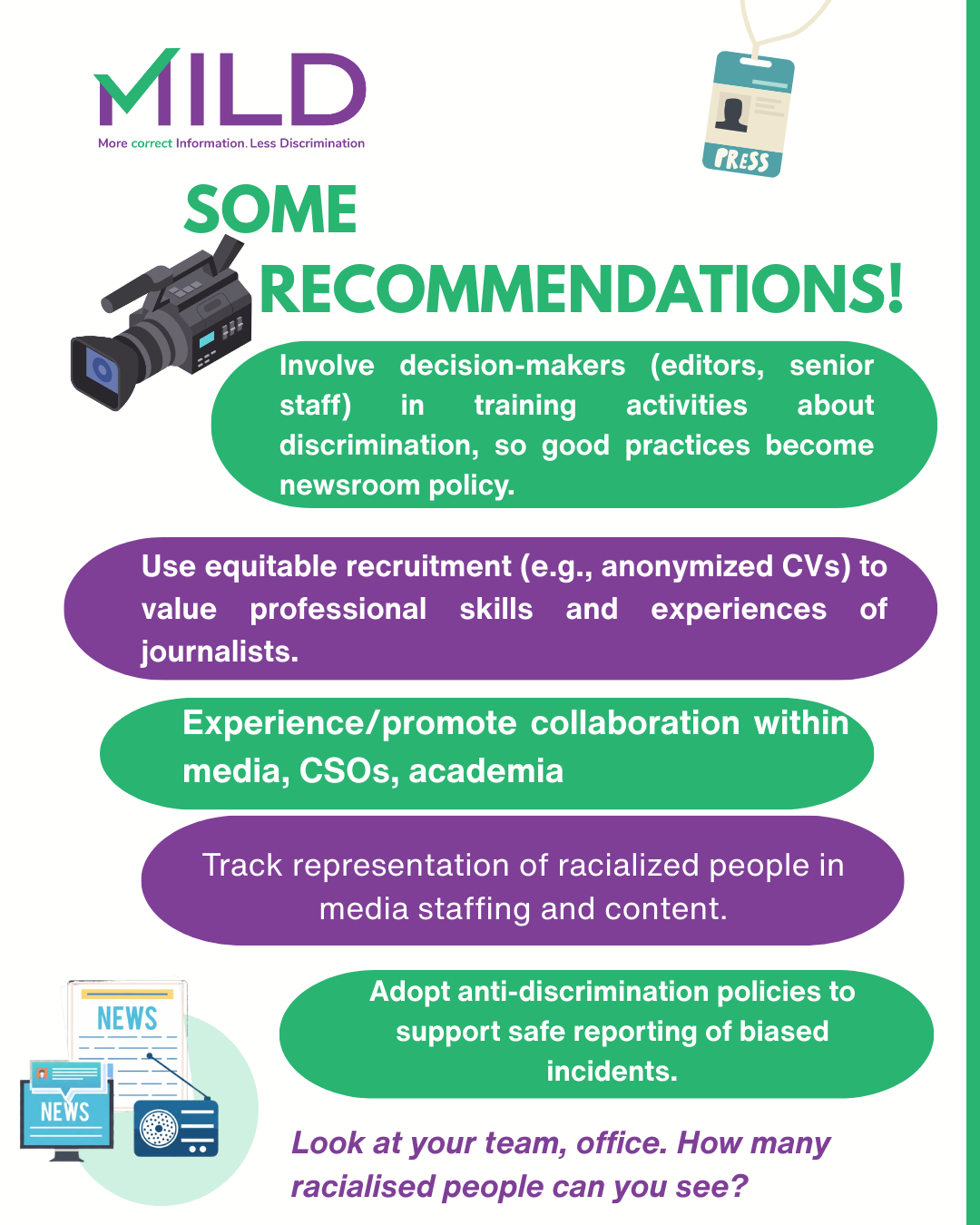
How to promote practices for broad information with the protagonism of racialized people and people with migrant backgrounds.
The interviews made for our research helped to identify several areas and ways of work that should be prioritized to trigger a structural change in how the media tend to portray and represent migrants, refugees, people with migratory backgrounds, and racialized individuals.
Quiz
▶ Quiz Module 5
Resources
Here you can find more additional resources
PDF List of Links
Downloadable Resources
Download supplementary materials to delve deeper into the topics covered in this module.