Learning objectives
In this module you will learn how words, depending on their context, can reinforce or dismantle racist and discriminatory biases and stereotypes, through a glossary designed to support a critical and responsible use of language and other materials, learners will be able to:
- Define what racism, discrimination, hate speech and hate crime are
- Understand how the wordings and language used in reporting can shape misleading and/or discriminatory narratives
- Share a glossary and some recommendations to avoid the use of discriminatory or incorrect language
Introduction
"Another racist attack: 'He was legally resident and well integrated'" or "Another racist attack: sixth case in two months".
The difference is minimal—just a few words—yet it is precisely through words that mental imagery and interpretations of reality are shaped. The media play a crucial role in constructing social imagery and in perpetuating it. When reporting on people with a migration background or racialised groups, information is often influenced by prejudices, stereotypes, and discrimination. Choices of wording, the inclusion of details about national origin or legal status, and other editorial decisions are never neutral. There's a structural connection between migration and racism, and it is reflected in the way stories about people with a migration background are reported. Even small linguistic choices can reinforce biases or shape public perception.
In this module, we will focus on language, providing:
- some basic definitions related to discrimination,
- a glossary of terms that are useful to know and, where possible, to avoid,
- practical tips on how to produce more accurate and less discriminatory journalism.
Some definitions
What is Racism? What is Discrimination? What is Hate Speech? What is Hate Crime?
In this section, we will define these three key terms in order to establish a shared understanding of racism, discrimination, and hate speech, and to make these phenomena easier to recognize when they occur, even beneath the surface of information.
You will find official or widely accepted definitions of these terms, along with examples from journalism and media communication that illustrate how discrimination, racism, and hate speech can manifest in real situations.
PDF MILD Some Definitions
Gallery of Incorrect reporting
This brief gallery presents real-life examples of problematic newspaper headlines or excerpts from articles (due to copyright restrictions, the authors and newspaper names have been removed from each example). The aim of this gallery is to illustrate how certain word choices shape specific imagery over time that reinforces stereotypes and may be discriminatory or racist, particularly in coverage related to migration or racialised people.
PDF MILD Gallery of Incorrect Reporting
Critical Glossary
The following glossary includes examples of words often used in journalism. It is divided into three categories, focusing on: legal terminology, terms between definition and self-definition, and words to be questioned.
This last category includes not only explicitly discriminatory terms, but also words that may appear neutral while actually embedding power dynamics or being stigmatising. For each term, you will find a definition and a critical note on the meaning it carries in contexts related to migration or racialised people.
An expanded downloadable version of this glossary is available below.
PDF MILD Critical Glossary
Tips and recommendations
Language is constantly evolving and continuously shaped through collective negotiation, which means that no definition can ever be entirely fixed or definitive. However, in this section you will find some recommendations or tips that can help you choose appropriate and accurate terminology, contributing to providing more correct information and less discrimination!
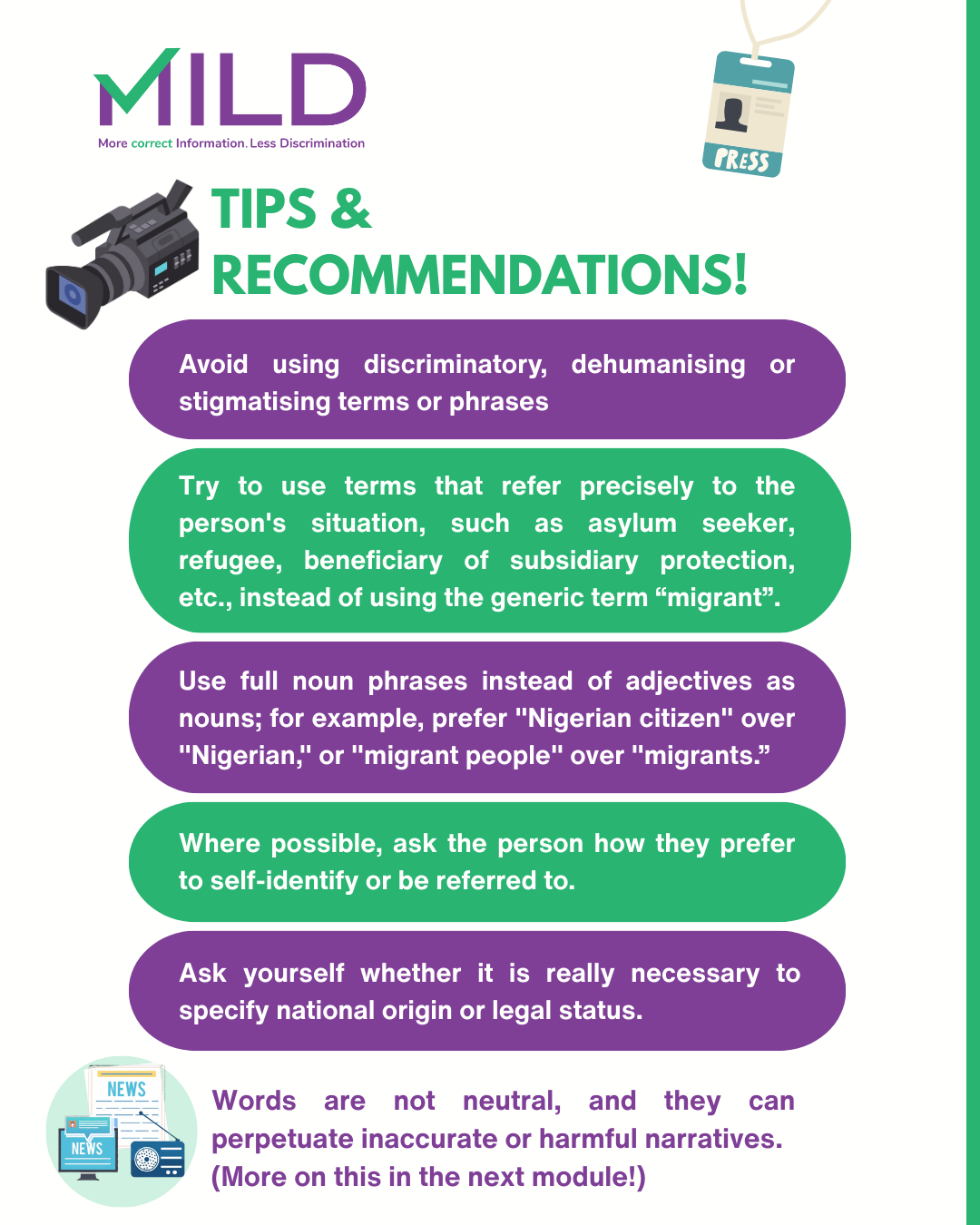
Infographic: Tips and recommendations
Additional resources
Here you can find a selection of third-party materials that are useful to delve deeper on the module's topics.
IGM (Institute of Maltese Journalists) launches anti-racism guidelines for media professionals. The guidelines are designed to support journalists, editors, and news managers in avoiding discriminatory language, stereotypes, and harmful narratives in their reporting.
MigraVoice is a cross-border community of experts with migration background, forming the MigraVoice Superpower Community, who make themselves available to European media journalists as reliable sources of knowledge across a wide range of disciplines.
Downloadable Resources
Download the materials of the module.